
The traditional leadership model has reached its cognitive ceiling. While IQ and EQ were once sufficient to navigate the professional world, modern leaders now face a vacuum of meaning that standard metrics cannot fill. You’ve likely felt the pressure as clients demand deeper purpose while you search for a framework that doesn’t feel too “new age” for a boardroom. This is where professional spiritual intelligence (SQ) teacher training becomes essential. It provides the intellectual rigour and secular methodology required to guide others through a systemic shift from ego-based reactions to soul-based intelligence.
You already know that true transformation requires more than just inspiration; it needs a disciplined and repeatable system. By pursuing a recognized certification, you can bridge the gap between internal wisdom and organizational excellence. This article outlines the systematic framework used to teach and facilitate SQ in modern corporate and personal environments. We’ll examine how to integrate these advanced cognitive dimensions into your current programs, ensuring you possess the authority to lead others toward higher functioning and moral clarity beyond the ego.
Key Takeaways
• Understand why IQ and EQ are no longer sufficient for complex global challenges and how SQ enables functioning from a state of wholeness.
• Master the 3Q model to integrate cognitive, emotional, and spiritual intelligences into a single, systematic framework for professional growth.
• Explore how spiritual intelligence teacher training provides the professional tools needed to facilitate mastery beyond the ego.
• Learn practical applications for SQ in executive coaching and corporate culture to foster wiser decisions and purpose-driven organizations.
• Review the curriculum of the 3Q Practitioner Certification Program to establish your authority as a recognized facilitator in the field.
The Emerging Need for Professional Spiritual Intelligence (SQ) Teachers
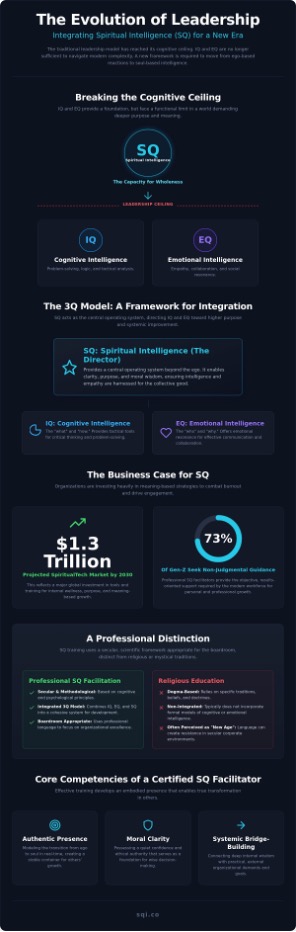
The professional landscape in 2026 demands a radical departure from outdated leadership paradigms. While cognitive intelligence (IQ) and emotional intelligence (EQ) were once the gold standards for success, they’ve reached a functional ceiling in the face of systemic volatility. Modern leaders are increasingly confronting a “meaning vacuum,” where traditional metrics of productivity fail to inspire or sustain long term engagement. Spiritual intelligence (SQ) provides the necessary evolution, defined as the capacity to operate from a state of wholeness that exists beyond the ego. It allows individuals to maintain clarity and purpose even when external structures are in flux.
The shift from “command and control” to purpose-driven leadership isn’t merely a trend; it’s a structural necessity. Organizations are realizing that without a systematic framework to access higher levels of awareness, teams remain trapped in reactive, ego-driven cycles. This creates a significant opportunity for those who undergo spiritual intelligence teacher training. These facilitators act as bridge-builders, helping professionals move from limited, self-interested perspectives to expansive, systemic ones that prioritize the collective good.
Why Organisations are Investing in SQ Facilitation
The SpiritualTech market is projected to grow to $1304.97 billion by 2030, reflecting a massive investment in internal wellness and meaning-based strategies. Organizations are turning to SQ facilitators to address the root causes of employee burnout. When work lacks a connection to a higher purpose, engagement withers. By integrating SQ, companies foster ethical decision-making that transcends short term gains. This is particularly vital as 73% of Gen-Z users report a preference for non-judgmental guidance in their personal growth. Professional SQ teachers provide this objective, results-oriented support, helping teams navigate uncertainty with a sense of moral clarity and stable internal grounding.
The Distinction Between SQ and Religious Education
Acritical component of spiritual intelligence teacher training is the mastery of a strictly secular, professional register. Unlike religious education, which relies on dogma or specific traditions, SQ focuses on the cognitive and emotional dimensions of the human experience. It uses the 3Q model, an integrated framework that combines IQ, EQ, and SQ into a cohesive system for development. This methodological approach ensures that the training remains appropriate for the boardroom. It appeals to the professional seeking organizational excellence by treating internal growth as a psychological and philosophical discipline rather than a mystical one. This distinction allows facilitators to introduce profound concepts of wholeness without triggering the resistance often associated with “new age” language.
Core Competencies of an SQ Teacher and Facilitator
Becoming an effective facilitator in this field requires more than just theoretical knowledge; it demands the embodiment of the states one intends to teach. Professional spiritual intelligence teacher training focuses on developing an authentic presence that allows the facilitator to model the transition from ego to soul in real time. This presence creates a stable container for others to explore their internal landscapes without the fear of judgment or the distractions of a self-interested ego. A teacher’s authority comes from this quiet confidence and moral clarity, which serves as a bridge between deep internal wisdom and practical organisational demands.
The 3Q Integration: IQ, EQ, and SQ
In a professional setting, the relationship between cognitive logic and social empathy must be clearly articulated to ensure credibility. IQ provides the tactical tools for problem-solving, while EQ offers the emotional resonance necessary for effective collaboration. However, without a central operating system to direct these faculties, they often serve the limited, defensive goals of the ego. SQ acts as this essential director, ensuring that intelligence and empathy are harnessed for systemic improvement and higher purpose. The 3Q model serves as the foundational architecture for professional SQ training, aligning cognitive logic and emotional resonance with a higher sense of meaning. By teaching this integration, facilitators help leaders move from fragmented functioning to a state of wholeness that benefits the entire organisation.
Facilitating the Shift Beyond the Ego
The core of SQ facilitation lies in helping clients distinguish between ego-driven motivations, such as the need for status or control, and soul-driven motivations, which focus on contribution and systemic health. This transition is particularly vital in high-pressure environments where stress often triggers reactive ego patterns that cloud judgment. Research into spiritual intelligence and mental health suggests that developing these internal capacities leads to greater resilience and psychological well-being in the face of professional challenges.
Facilitators use specific techniques to cultivate “Deep Presence,” a state of heightened awareness that allows for self-observation without judgment. This process is governed by a strict ethical framework, ensuring that the exploration of deep internal states remains professional and results-oriented rather than sentimentally mystical. If you’re ready to master these competencies, exploring a Practitioner Training program is the next logical step in your professional development. By modeling these states, you teach others to see the interconnectedness of organizational health and personal integrity, leading to a more sustainable and ethical corporate landscape.
Methodology and Pedagogy: How to Teach Spiritual Intelligence
Teaching SQ is a disciplined journey that moves from conceptual understanding to lived experience. Professional spiritual intelligence teacher training provides a structured four-step methodology designed to guide this evolution within a secular, professional context. The pedagogy focuses on transforming the student’s internal state so they can, in turn, facilitate that shift for others.
Step 1: Establishing Intellectual Grounding. We begin by moving from theory to experience. Research in Spiritual Intelligence in Teacher Education suggests that for training to be effective, educators must first internalise these dimensions as cognitive capacities. This step ensures the student understands SQ as a systematic framework for leading beyond the ego.
Step 2: Identifying Ego-Patterns. Facilitators teach the discipline of self-observation. Students learn to witness their reactive behaviors, such as the need for control or status, without judgment. This non-judgmental awareness is the essential prerequisite for moving into a state of wholeness.
Step 3: Accessing the Field of SQ. This phase involves practical exercises for shifting states. Participants learn to move beyond the ego’s narrow, defensive focus to access a wider field of awareness characterised by clarity and systemic perspective.
Step 4: Systemic Application. The final step integrates these shifts into daily professional workflows. Facilitators help students apply their expanded awareness to decision-making, conflict resolution, and organizational health, ensuring that internal growth translates into professional excellence.
Secular SQ Tools and Exercises
To maintain professional rigor, facilitators use objective “SQ Metrics” to provide students with measurable feedback. This data-driven approach removes the ambiguity often found in personal development programs. By reframing traditional wisdom into modern psychological and leadership language, teachers make profound concepts accessible to corporate audiences. Creating a safe “liminal space” is also vital. This is a temporary, protected environment in a workshop where participants feel secure enough to drop their professional masks and engage in genuine transformation.
The Role of the Facilitator in SQ Development
Effective spiritual intelligence teacher training emphasizes the transition from being an “expert” to becoming a “facilitator.” This approach allows the student’s own SQ to emerge rather than imposing a specific belief system. When handling skepticism in the corporate classroom, the facilitator relies on logical progression and empirical evidence. Ultimately, the teacher’s authority depends on their own ongoing practice. You can’t lead others where you haven’t gone yourself. Maintaining a disciplined internal practice ensures the facilitator speaks with the calm authority of someone who has successfully bridged the gap between deep wisdom and practical demands.
Professional Applications for Certified SQ Practitioners
Certification in this field isn’t just an academic achievement; it’s a professional differentiator that opens doors to high-level consulting and leadership roles. As organizations recognize that technical skills alone don’t solve systemic crises, the demand for practitioners who can facilitate deep internal growth has surged. Earning your credentials through spiritual intelligence teacher training allows you to offer a systematic framework that goes beyond the surface level of traditional soft skills training. It moves you from being a generalist to a specialist in systemic transformation.
SQ for Executive Coaches and Consultants
Executive coaches find that SQ provides the missing link in leadership development. While many leaders are proficient in IQ and EQ, they often struggle with the ethical complexities and systemic pressures of the C-suite. By positioning SQ as a tool for wiser decision-making beyond self-interest, you can speak the language of ROI that executives value. You’re not just selling a vague concept; you’re selling the capacity for clear judgment under pressure and the reduction of ego-driven friction that often derails corporate strategy. This specialized certification distinguishes your practice, allowing you to move from tactical coaching to transformative partnership.
SQ in HR and Organizational Development
Within Human Resources, SQ is becoming the foundation for purpose-driven cultures. Practitioners use SQ metrics to assess the health of an organization’s internal state, providing data-driven insights into culture and engagement. This approach helps in several key areas:
• Retention and Engagement: Building a culture where employees feel a sense of wholeness and purpose leads to higher retention rates.
• Conflict Resolution: Facilitators use SQ to help teams find “third-way” solutions, moving past the binary win-lose mindset of the ego.
• Leadership Pipelines: Integrating SQ into development programs ensures that the next generation of managers leads with systemic awareness and compassion.
Strategic planning also benefits from an SQ-informed perspective. When leaders operate beyond the ego, their long-term visioning becomes more sustainable and ethically grounded. They begin to see the organization as an interconnected system rather than a collection of isolated silos. If you’re ready to integrate these advanced methodologies into your professional toolkit, you can apply for the Practitioner Certification Program to begin your journey toward mastery.
The Spiritual Intelligence Practitioner Certification Program
The Spiritual Intelligence Practitioner Certification Program represents the definitive standard for those seeking to facilitate mastery beyond the ego. This program is specifically engineered for professionals who require a secular, systematic framework to address the deep internal needs of their clients. While other programs might focus solely on personal reflection, our spiritual intelligence teacher training equips you with the pedagogical tools to transform organizational culture and executive performance. It offers a rigorous path to becoming a recognized authority in the application of the 3Q model, bridging the gap between internal wisdom and the metrics of corporate productivity.
The curriculum moves logically from foundational theory to advanced facilitation. You’ll begin by mastering the philosophical and psychological underpinnings of SQ before progressing to practical application. This ensures that every practitioner isn’t just a teacher of concepts, but a guide who can navigate the complexities of the human psyche in a professional setting. The certification process involves a comprehensive assessment of both your theoretical understanding and your ability to model SQ states during facilitation. Upon completion, you join a global community of SQ professionals and bridge-builders who are equally comfortable discussing the nuances of the human psyche and the metrics of organizational excellence.
What to Expect from the Practitioner Training
Enrolling in this program means committing to a deep dive into the systematic framework of SQ development. You’ll gain access to proprietary SQ tools and assessment metrics that allow for objective feedback in a corporate environment. The training covers specific methodologies needed to facilitate the ego-to-soul transition, ensuring you can handle high-pressure scenarios with quiet confidence. You’ll learn to use these metrics to track progress, providing the empirical evidence that modern organizations demand. This rigorous approach ensures that your work remains intellectually grounded and results-oriented, moving students toward a holistic understanding through well-defined steps.
Next Steps: Enrolling in the 2026 Cohort
The roadmap from student to certified SQ facilitator is clear and methodical. Professional practitioner training typically requires a background in leadership, coaching, or organizational development to ensure participants can immediately apply the 3Q model to their existing work. By joining this cohort, you become part of a global network dedicated to systemic improvement and social responsibility. This network provides ongoing support as you integrate these advanced cognitive dimensions into your professional practice. If you’re ready to lead others toward higher functioning, you can apply for the Spiritual Intelligence Practitioner Training to secure your place in our upcoming session.
Mastering the Future of Leadership and Facilitation
The transition from ego-driven reactions to systemic wholeness is no longer a luxury; it’s a strategic imperative for the modern professional. We’ve explored how the systematic 3Q framework provides the intellectual grounding required to facilitate this shift within high-pressure corporate environments. By mastering these secular methodologies, you don’t just acquire a new skill set. You join a prestigious global community of SQ experts dedicated to restoring meaning and ethical clarity to the workplace. This professional path demands discipline and deep presence, yet it offers the most reliable route to sustainable organisational health.
Enrolling in a professional spiritual intelligence teacher training program is the definitive step toward establishing your authority as a bridge-builder. You’ll move beyond the cognitive ceilings of IQ and EQ to lead others toward a state of expansive, soul-driven intelligence. This Practitioner Certification provides the recognized credentials and proprietary tools needed to integrate SQ into existing leadership pipelines and strategic visioning. If you’re ready to transcend limited perspectives and guide others toward their highest functioning, the next step is clear. Become a Certified Spiritual Intelligence Practitioner and lead the evolution of professional excellence with quiet confidence and moral clarity.
Frequently Asked Questions
Is spiritual intelligence teacher training religious in nature?
No, this training is strictly secular and professional. It relies on psychological and philosophical frameworks rather than religious dogma. The curriculum focuses on cognitive and emotional dimensions of wholeness, making it suitable for corporate boardrooms and secular educational environments. By avoiding mystical language, the program ensures that practitioners can facilitate internal growth without conflicting with a client’s personal beliefs or organizational policies.
How long does it take to become a certified SQ practitioner?
The duration of the program varies depending on the specific cohort, but it typically involves several months of disciplined study and practice. This timeframe allows students to move from foundational theory to advanced facilitation mastery. Because the training requires the integration of complex internal states, the pace is methodical and thorough. Prospective students should check the current schedule for the upcoming cohort to confirm exact start dates and the total number of contact hours required.
Can I use SQ certification for executive coaching?
Yes, SQ certification is highly effective for executive coaching as it provides a framework for wiser decision-making beyond self-interest. High-level leaders often face complex systemic challenges that require more than just IQ or EQ. By integrating spiritual intelligence teacher training into your practice, you can help executives reduce ego-driven friction and align their leadership with a higher sense of purpose, resulting in improved organizational health and moral clarity.
What is the difference between an SQ coach and a traditional life coach?
An SQ coach focuses specifically on the transition from ego-based functioning to a state of wholeness, whereas traditional life coaches often focus on tactical goal-setting or emotional management. While a life coach might help a client achieve external success, an SQ practitioner facilitates deep internal transformation. This involves teaching others to observe their ego-patterns without judgment and access a wider field of awareness that informs their professional and personal lives.
Do I need prior experience in spirituality to take this training?
No prior experience in spiritual traditions is required, though a background in leadership, human resources, or professional coaching is highly beneficial. The program is designed for experts who want to add a systematic internal framework to their existing professional toolkit. Because the curriculum is secular and intellectually grounded, it appeals to those who value logic and results-oriented growth over mystical or “new age” approaches to personal development.
How is the 3Q model used in the certification program?
The 3Q model serves as the central architecture of the certification, integrating IQ, EQ, and SQ into a single, cohesive system. Students learn how cognitive logic and social empathy are directed by spiritual intelligence to achieve systemic improvement. This framework allows practitioners to provide objective feedback to their clients, ensuring that the process of internal growth remains structured, measurable, and directly applicable to the demands of the modern corporate landscape.
Is the SQ teacher training available online?
Yes, the program is designed to be accessible to a global community of professionals through digital platforms. This online format includes a mix of theoretical study, practical exercises, and interactive facilitation sessions. By utilizing digital tools, spiritual intelligence teacher training allows students to absorb the material at a steady pace while engaging with a diverse network of bridge-builders and visionary leaders from across the globe, all within a professional virtual environment.
What professional credentials do I receive upon completion?
Upon successful completion, you receive a professional Practitioner Certification in Spiritual Intelligence. This credential establishes your authority as a recognized facilitator who is capable of teaching the 3Q model and guiding others beyond the ego. It distinguishes your practice in the marketplace, signaling to potential clients and organizations that you possess the rigorous training and moral clarity required to lead high-level systemic transformation and meaningful organisational change.
© 2026, Richard Griffiths.