Implementing SQ Skills: A Professional Development Roadmap
Developing SQ skills for professional development is not an overnight transformation; it’s a disciplined, methodological journey toward higher cognitive functioning. This roadmap moves beyond the theoretical and provides a structured path for professionals who seek to embody systemic mastery. By following a systematic approach, you can transition from reactive, ego-driven management to a state of calm, authoritative leadership. The process requires both internal reflection and practical application in the high-stakes environment of the modern office.
Step 1: Assessment. Begin by identifying your current reliance on ego-driven patterns. This involves recognizing moments of defensive posturing, status-seeking, or fear-based decision-making. Honest assessment is the prerequisite for any meaningful shift in intelligence.
Step 2: Cultivating Presence. Strengthen the “observing self” through daily practices. This capacity allows you to witness your thoughts and emotions without being controlled by them, creating the mental space necessary for objective analysis.
Step 3: Purpose Refinement. Align your daily tasks with a systemic contribution. Instead of focusing solely on personal or departmental KPIs, evaluate how your work serves the health and sustainability of the entire organisation and its stakeholders.
Step 4: Integration. Apply your SQ skills to specific professional challenges. Use your expanded awareness to navigate complex organisational conflicts or to design long-term strategies that account for systemic volatility.
To deepen this journey and gain the tools to lead others, you can pursue professional certification through our .Practitioner Training in Spiritual Intelligence.
Daily Practices for the Modern Professional
Consistency is the engine of growth. Secular meditation techniques, adapted for the boardroom, help maintain the “witness state” even during intense negotiations. Reflective journaling serves as a rigorous tool to track your transition from ego-driven reactions to soul-driven responses, providing a clear record of your cognitive evolution. Before major decisions, utilize a “Three-Question Check-in” to ensure alignment: Who is making this decision? What is the systemic impact? Does this align with our core purpose?
Measuring Growth in Spiritual Intelligence
While SQ addresses internal states, its impact is visible through both qualitative and quantitative metrics. Qualitatively, you’ll notice improved professional relationships, significantly reduced stress, and a marked increase in creative problem-solving. Quantitatively, these internal shifts translate to higher employee retention, better systemic problem-solving, and clearer execution of organizational strategy. Using these metrics allows you to justify the investment in SQ skills for professional development to stakeholders, demonstrating that higher intelligence leads to superior organizational performance.
Achieving Professional Mastery through SQ Practitioner Training
The journey toward systemic mastery concludes with a formal commitment to a disciplined methodology. While individual practice is foundational, the Practitioner Training in Spiritual Intelligence provides the professional rigour required to lead others through similar transformations. This certification represents a definitive path for facilitators who recognize that generic EQ coaching has reached a point of saturation. By focusing on a systematized framework, practitioners gain the tools to address the root causes of organisational stagnation rather than merely managing the emotional symptoms. This approach ensures that leadership development is not just about behavioural modification but about fundamental cognitive evolution.
This training functions as a vital bridge-builder. It successfully connects the nuances of internal wisdom with the hard metrics of corporate productivity. Professionals who complete the program don’t just learn abstract concepts; they master specific methodologies to implement SQ skills for professional development across diverse organisational structures. This ensures that the transition from ego-driven to soul-driven performance is both measurable and sustainable, providing a clear return on investment for the organization. By grounding internal growth in professional rigour, you create a vision of excellence that is both profound and attainable.
Why Certification Matters for Professionals
Establishing credibility in a secular professional environment requires a methodology that is both transparent and repeatable. The 3Q framework offers this precision, moving away from the “new age” ambiguity that often hampers internal growth initiatives. By becoming certified, you join a global community of practitioners dedicated to systemic change. This network provides a collaborative environment for those who seek to apply high-level cognitive dimensions to real-world business challenges, ensuring that your practice remains grounded in both ethics and results. This professional rigour is what separates a certified expert from a generalist coach.
Taking the Next Step in Your Career
In the competitive landscape of 2026, technical skills and emotional awareness are baseline requirements. True differentiation comes from the ability to navigate uncertainty with quiet confidence and moral clarity. Developing SQ skills for professional development allows you to lead beyond the ego, creating high-functioning teams that operate from a state of collaboration rather than scarcity. This capacity for transformative leadership is the hallmark of a seasoned expert. If you’re ready to transition from a participant to an authoritative guide, you can start your journey to
Become a Certified SQ Practitioner today. This step marks the beginning of a higher level of professional functioning, where your career goals align perfectly with a sense of universal responsibility.
Advancing Toward Systemic Leadership Mastery
The transition from ego-driven management to systemic mastery is the defining challenge for professionals in 2026. You’ve explored how Spiritual Intelligence serves as the essential operating system, allowing your technical logic and emotional awareness to function with greater purpose. By prioritizing SQ skills for professional development, you ensure your leadership remains resilient even in the face of global uncertainty and organisational volatility. This shift doesn’t just improve your internal state; it fundamentally evolves the culture and effectiveness of your entire team.
True mastery requires a move beyond theoretical understanding toward a disciplined, methodological application. You can master the science of SQ with our Practitioner Training, which offers a secular, research-based curriculum designed for the modern corporate environment. This program provides professional certification for coaches and leaders, connecting you with a global network of SQ practitioners dedicated to ethical, systemic change. We invite you to take this final step toward higher cognitive functioning and professional excellence. Your journey toward a more expansive and meaningful career starts with this commitment to internal growth.
Frequently Asked Questions
What are the most important SQ skills for a manager?
The most critical skills include self-transcendence, purpose-alignment, and systemic wisdom. These capabilities allow a manager to observe their own biases while simultaneously perceiving the complex interdependencies within their team. By stepping back from the ego, a leader can move from personal status-seeking toward decisions that benefit the entire organizational ecosystem.
Is spiritual intelligence different from religious belief?
Spiritual intelligence is a secular, cognitive capacity that is entirely distinct from religious belief. It relies on psychological frameworks and intellectual rigour to explore meaning and wholeness rather than adhering to specific theological doctrines. This methodological approach ensures that SQ remains a professional tool for internal growth that is accessible to individuals of all backgrounds.
How can I develop SQ skills while working a high-pressure job?
You can develop these skills by integrating brief, disciplined pauses into your existing schedule. Applying SQ skills for professional development doesn’t require extra time; it requires a shift in how you process high-pressure data during your workday. Techniques like the “systemic pause” allow you to re-center your awareness before making high-stakes decisions.
Can spiritual intelligence be measured in a professional setting?
SQ can be measured through a combination of qualitative leadership assessments, neurological testing using a brain-sensing headband, and quantitative organisational results. Growth is evidenced by a leader’s increased ability to maintain calm authority during crises and by measurable improvements in team psychological safety. These internal shifts eventually manifest as higher retention rates and more effective strategy execution.
What is the 3Q model of intelligence?
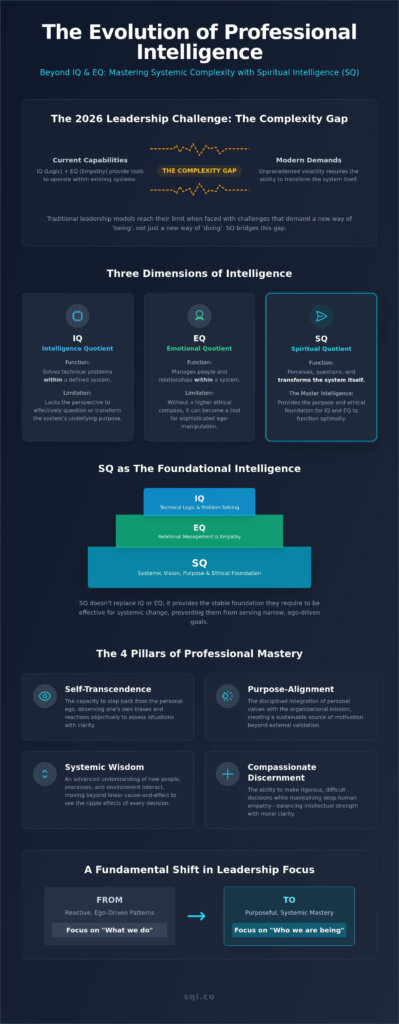
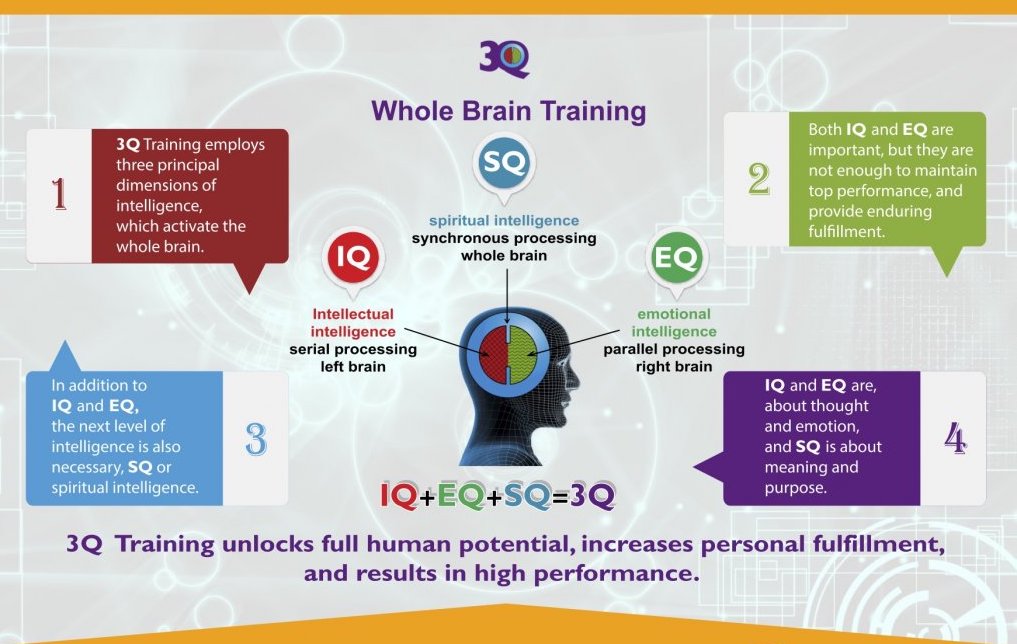
The 3Q model is a holistic framework that integrates IQ for technical logic, EQ for relational management, and SQ for systemic purpose. SQ serves as the master intelligence that ensures IQ and EQ are utilized for ethical and sustainable outcomes. Without the governing purpose of SQ, technical and emotional skills often remain limited by ego-driven objectives.
How does SQ improve decision-making in business?
SQ improves decision-making by shifting the leader’s internal state from reactive survival to creative vision. This shift activates higher-order cognitive functions in the prefrontal cortex, enabling the professional to see long-term consequences that are often obscured by short-term ego needs. The result is a strategy that is both intellectually rigorous and ethically sound.
What is the difference between a life coach and an SQ practitioner?
An SQ practitioner is a certified guide who utilizes a systematized methodology to develop an individual’s internal intelligence. While life coaching often addresses external goals or behavioural changes, SQ practitioners focus on the internal cognitive architecture required for systemic mastery. This professional rigour ensures that the transformation is grounded in a researched and repeatable framework.
© 2026, Richard Griffiths.